Overview
Context: Undergraduate thesis research at the University of Chinese Academy of Sciences, advised by Prof. Wu Zhou.
Atomic-resolution STEM can provide the coordinates of atoms in two-dimensional amorphous materials, but coordinates alone do not reveal which local structural motifs are important or how those motifs vary across a sample. Conventional descriptors—such as radial distribution functions, ring statistics, bond lengths, and bond angles—capture selected properties but can miss relationships between different structural features.
This project explores a data-driven alternative: learning a compact, rotation-invariant representation directly from local microscopy image patches.
Preparing experimental images
The preprocessing pipeline identifies atoms while separating the material from contamination and vacuum regions. Local patches are then centered on atoms or ring-like structural units so that the representation model receives comparable local environments.
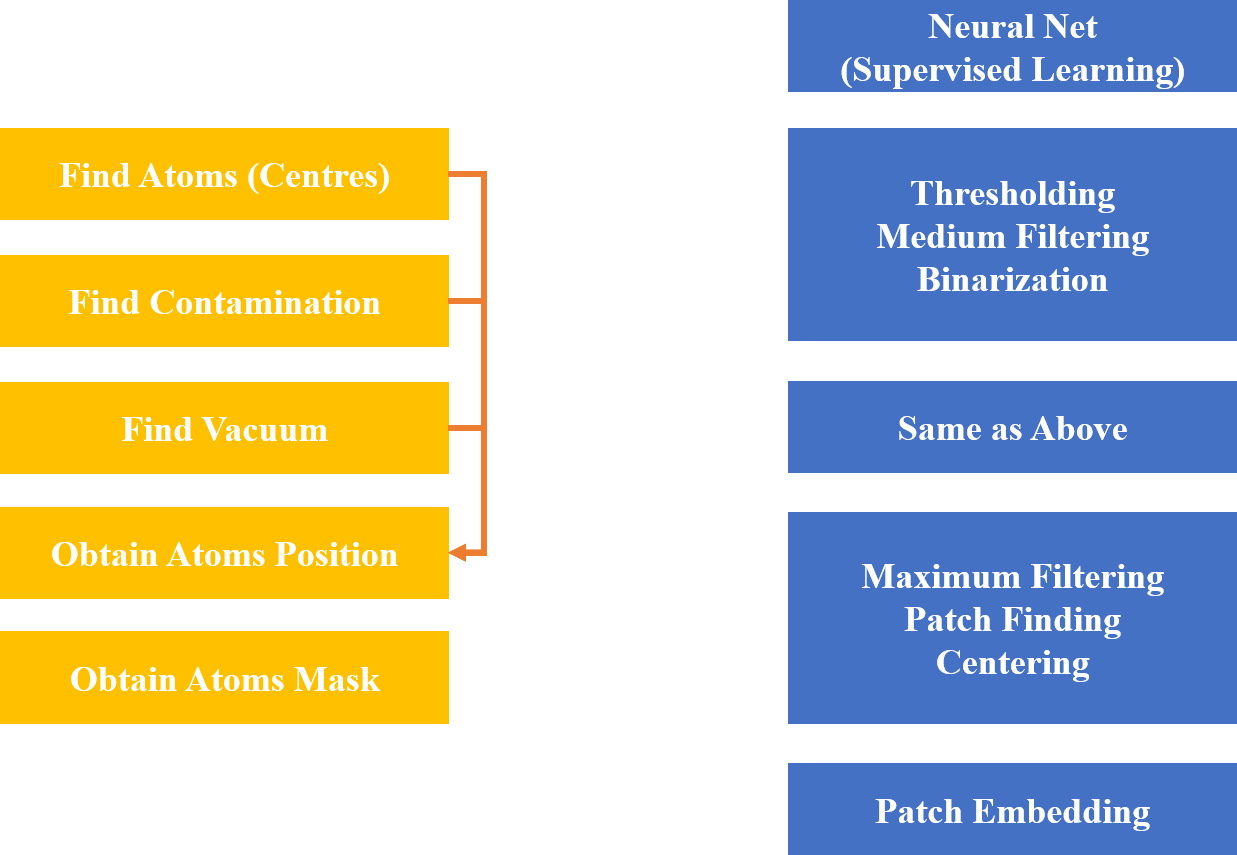
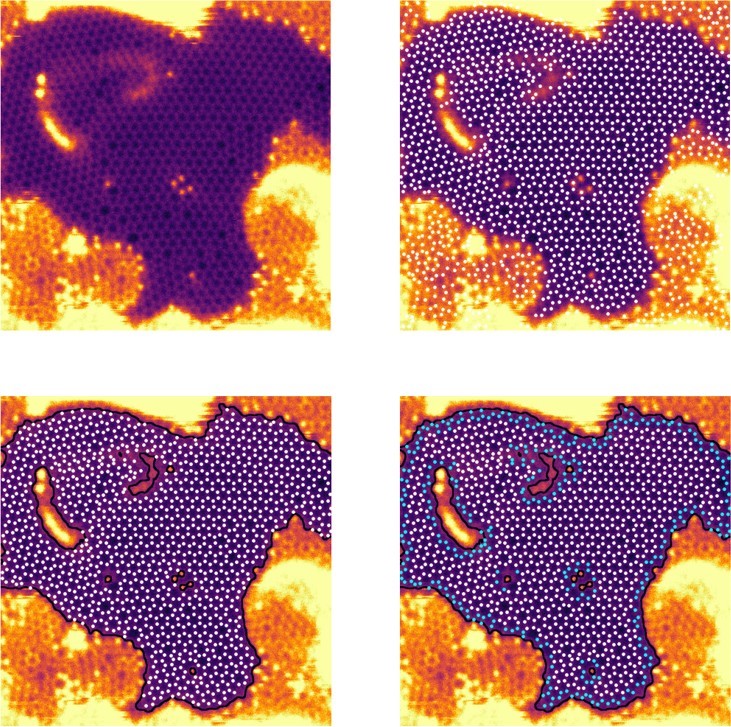
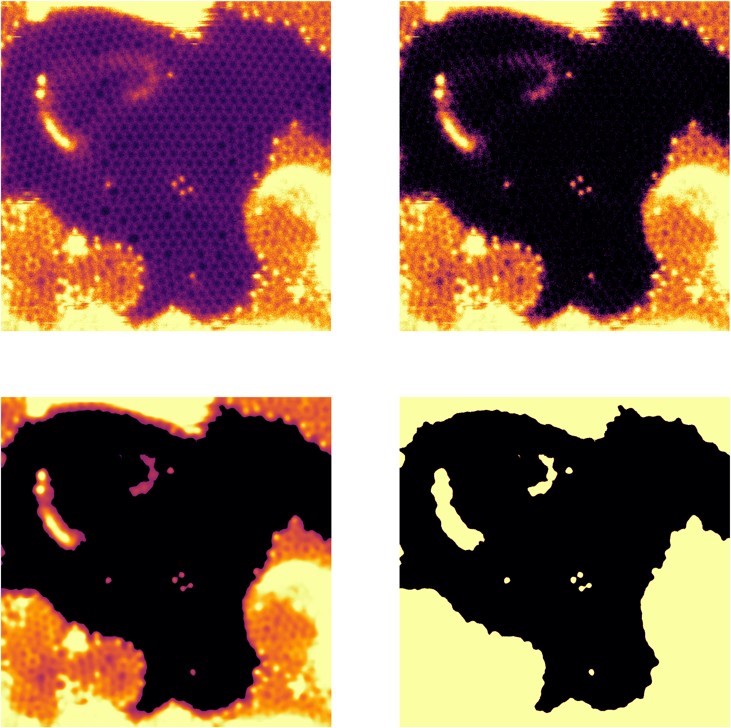
Building local-structure datasets
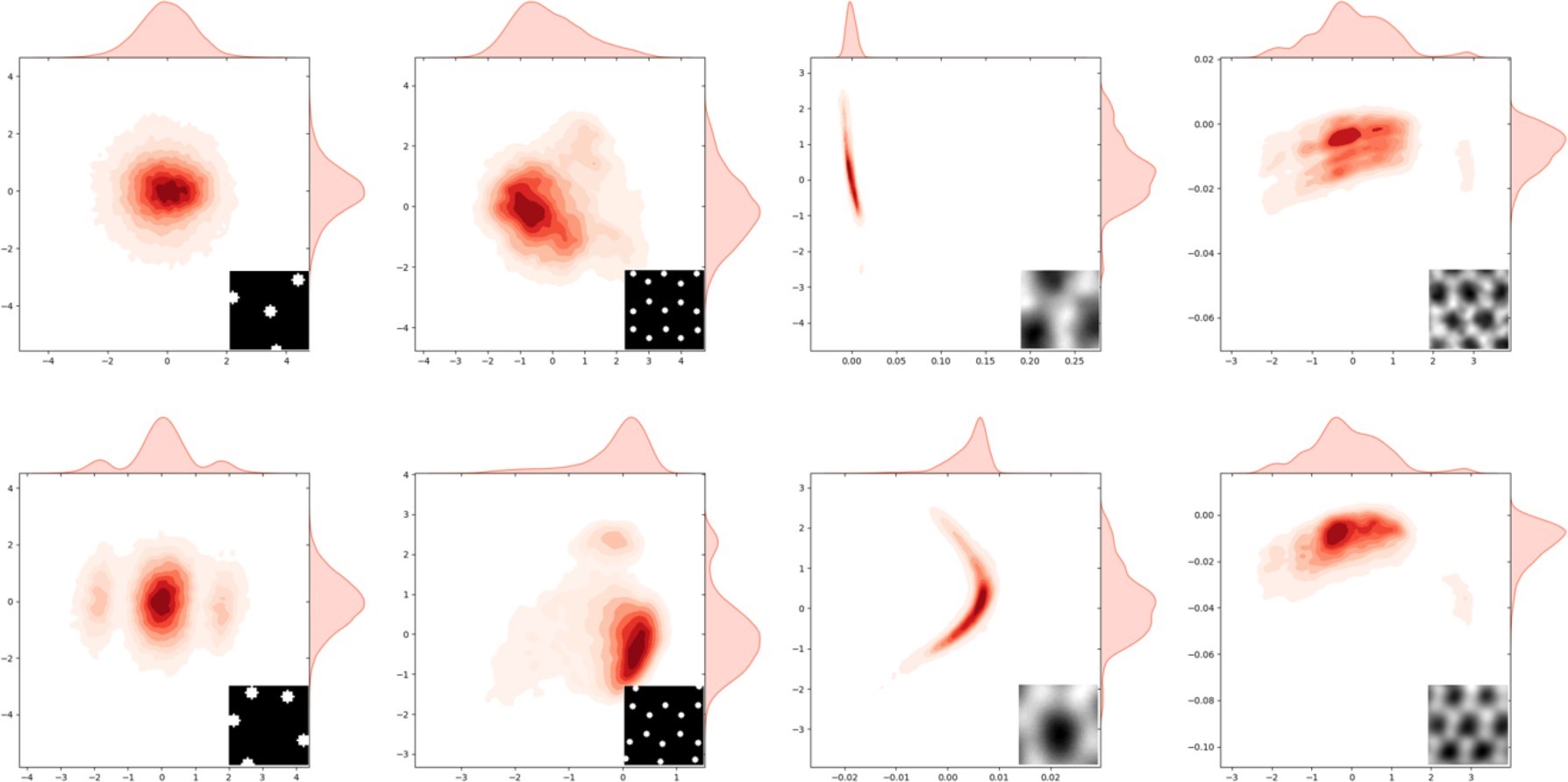
To test what information can be learned, the project constructed multiple datasets that vary how local patches are centered, masked, denoised, and cropped. This makes it possible to distinguish structural information from artifacts introduced by a particular preprocessing choice.
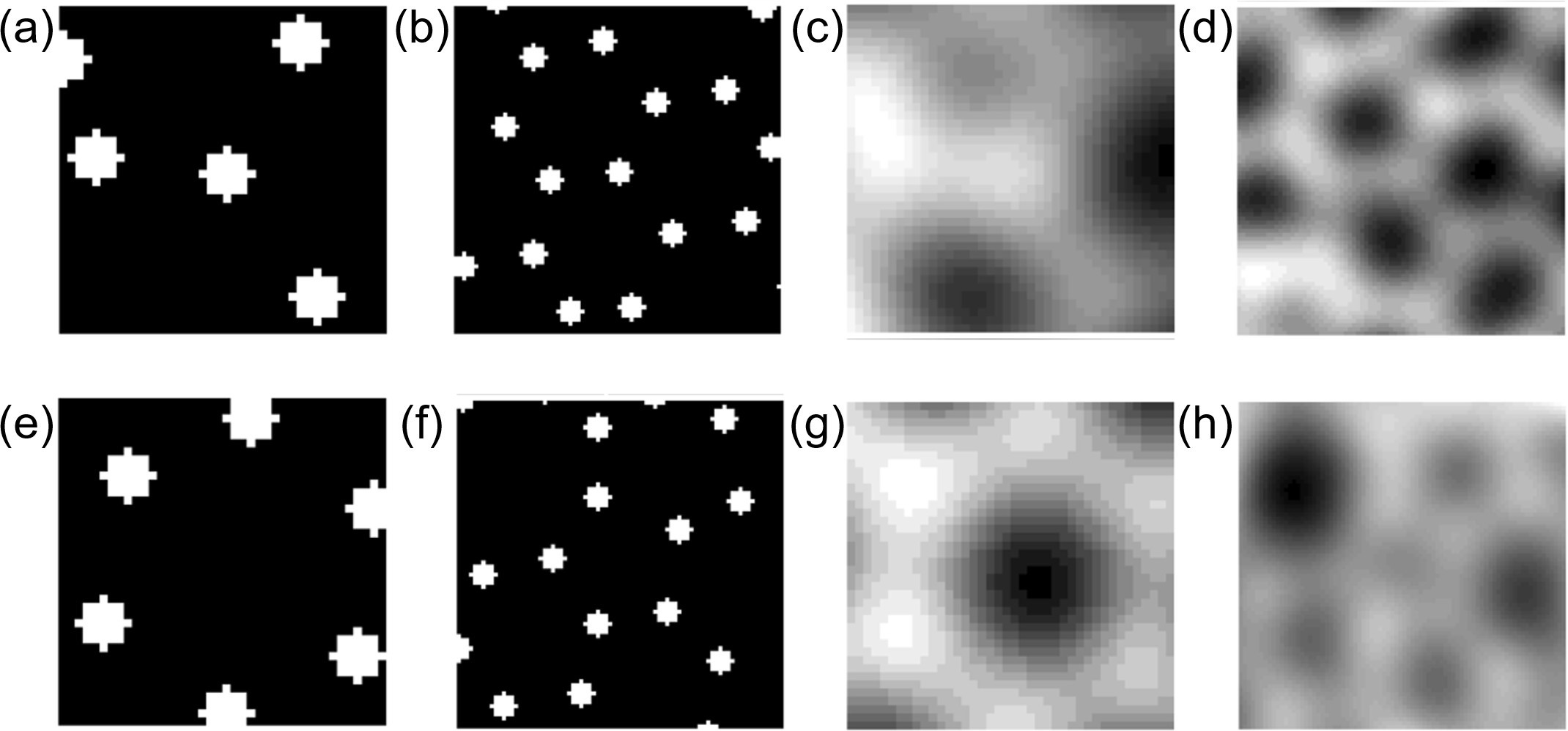
Rotation-invariant representation learning
A rotation-invariant variational autoencoder (r-VAE) maps each local environment to a low-dimensional latent representation. Rotation invariance is important because a structural motif should retain the same physical meaning when the microscopy image is rotated.
Physical interpretation
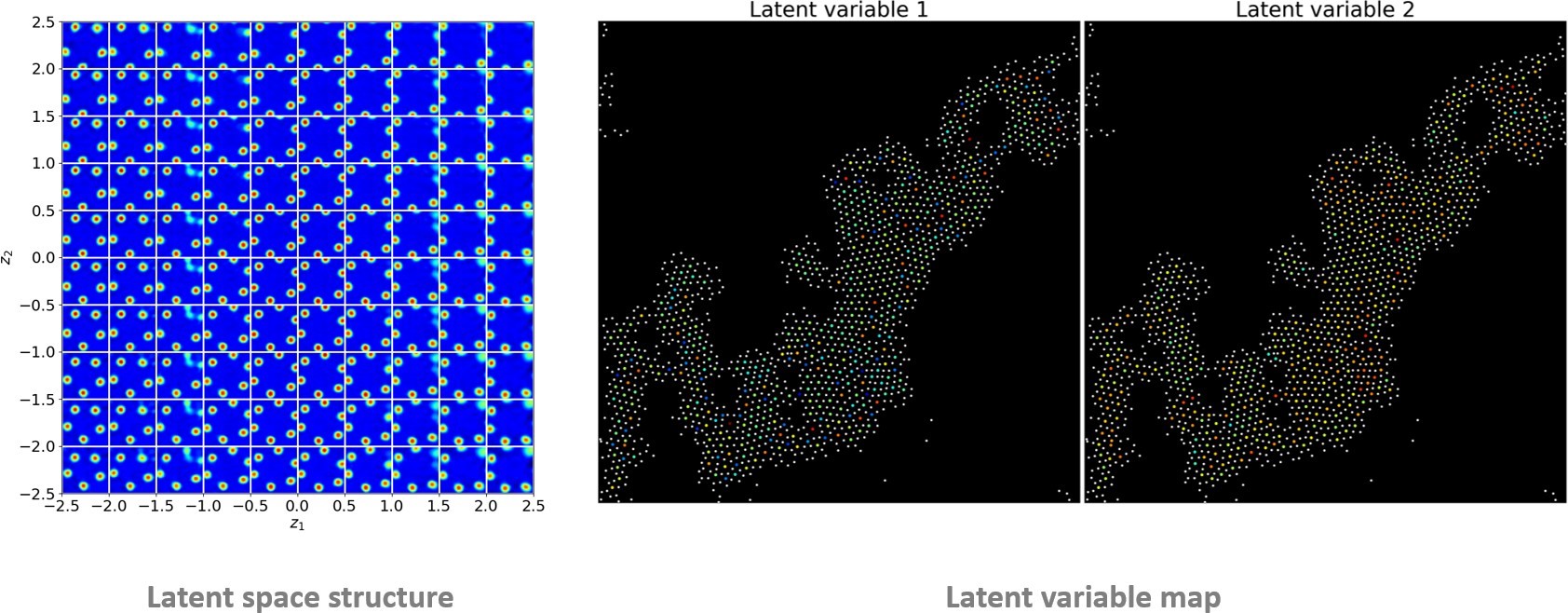
The learned latent coordinates track interpretable changes in local structure, including carbon-ring type and size. Mapping these variables back to real space provides a spatial description of how local structural motifs vary across the amorphous network.
What I built
- Preprocessing for atom, contamination, and vacuum-region identification.
- Local-patch datasets designed to test the robustness of learned features.
- Rotation-invariant representation learning for noisy experimental images.
- Real-space maps connecting latent variables to physically meaningful local motifs.
This work forms the structural-discovery branch of the DeepSTEM research series.